100 % Explainable AI Solutions
Every result produced by a GenerIA AI includes by default a clear justification, relevant metrics, complete traceability and direct access to the sources on which it is grounded. Users can understand not only what the system answered, but also why it answered that way and which information supported its response.
Beyond individual results, built-in telemetry provides the logs, metrics and traces needed to observe behavior, assess performance, identify anomalies and detect model drift. These data can also be integrated into the monitoring, reporting and auditing systems you already use.
Explainability turns AI from an opaque black box into an accountable business capability - one that your users can understand, your experts can improve and your organization can trust.
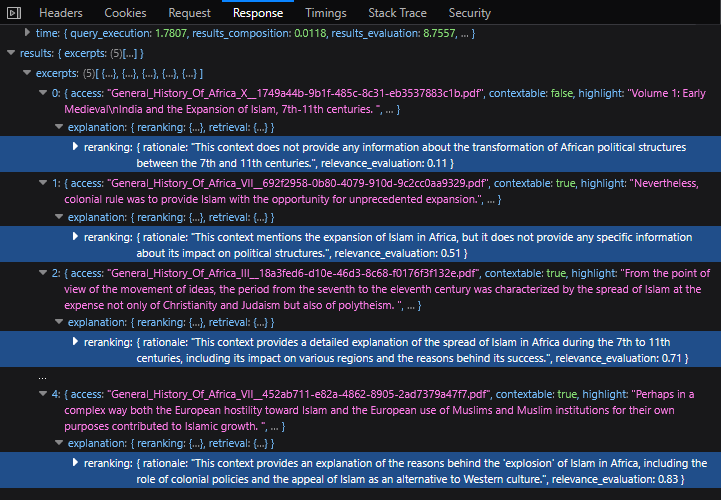
Sample response payload for a request. The "explanation" section details, among other things, the reasoning behind the ranking of the results. Note: this is a composite screenshot. The full payload is displayed below.
Understand every response
An answer is not truly useful when its users cannot determine where it came from, why it was produced or whether it should be trusted.
Grounded results - GenerIA AI solutions provide direct access to the documents and information sources used to construct a response. Users can inspect the supporting material instead of accepting an unsupported statement from an opaque model.
Explicit justification - By default, explanations are included alongside results to identify the reasoning, rules, evidence or processing steps that contributed to them. The appropriate form of explanation depends on the use case: a citizen, an expert and an auditor do not require the same level of detail.
Metrics and traceability - Application-specific metrics and trace identifiers can accompany every response, depending on your applicative needs. These elements make it possible to connect what the user sees with the retrieval, model execution and software operations that produced it.
Explainable to users, experts and auditors
Explainability at every level - For end users, it means receiving understandable answers supported by accessible sources. For domain experts, it means being able to verify the information selected and identify incorrect interpretations. For engineering teams, it means observing each stage of the execution pipeline. For auditors, it means retaining the provenance and history needed to trace and reconstruct an operation.
Smart observability layering - This layered approach allows transparency to be adapted without disclosing confidential implementation details or protected intellectual property.

Full response payload for a request to a GenerIA RAG system. TL;DR: all the necessary explanations are included, allowing every audience (users, engineers, auditors, etc.) to understand and trace every aspect of the answers.
This screenshot is scrollable.
From individual responses to continuous oversight
Explainability is not limited to displaying citations. The system itself must remain observable over time.
Built-in telemetry - GenerIA solutions can track usage patterns, application performance, retrieval behavior, model execution and user evaluations. This helps technical and business teams detect anomalies, identify recurring weaknesses, observe model or data drift and measure the effect of successive improvements.
In real life - The result is an AI whose performance can be examined and governed under real operating conditions, not merely demonstrated through a one-time benchmark.
Human control remains central
GenerIA AI solutions are designed to augment professional expertise, not to make accountability disappear behind an algorithm.
Explanations and traceability enable users to challenge results, compare them with authoritative information and retain meaningful control over consequential decisions.
When a result is corrected or rejected, that feedback can also become a measurable signal for subsequent evaluation and improvement.
How do we do it?
Source-level provenance - During ingestion, documents and records retain identifiers, versions, metadata and access information. Content derived from a source remains linked to that source throughout indexing and retrieval.
Traceable RAG pipelines - In Retrieval-Augmented Generation (RAG) systems, the retrieval query, selected information, ranking operations, context assembly and model generation can be associated with a common detailed execution trace. This makes it faster and easier to distinguish problems caused by missing data, poor retrieval, inappropriate context or model generation.
Machine-readable result payloads - GenerIA AIs' responses can be returned with machine-readable fields containing source references, justifications, application metrics and trace identifiers. Customer-facing interfaces can display these elements directly, while other applications can store or process them programmatically, which enables a broader range of process automation scenarios.
Distributed execution tracing - The main stages of a request - authentication, retrieval, reranking, prompt construction, inference, validation and post-processing - can be instrumented independently. Engineers can inspect latency, errors and behavior at the component level instead of treating the AI as a single indivisible black box.
OpenTelemetry-based observability - Metrics, traces and logs can be exported through open-source, industry-standard OpenTelemetry and integrated into the organization's existing monitoring tools. Collection, persistence and visualization components remain replaceable, avoiding dependency on any observability platform.
Versioned data lineage - Dataset versions, indexes and authoritative sources can be recorded so that a historical answer can be related to the exact information available when it was generated. This lineage is essential when content changes over time or when a result must be reproduced for audit purposes.
Continuous evaluation - Automated test sets, user feedback, relevance assessments and production metrics can be compared across model, prompt, retrieval or data changes. Improvements therefore remain measurable, reversible and attributable to specific system modifications.